
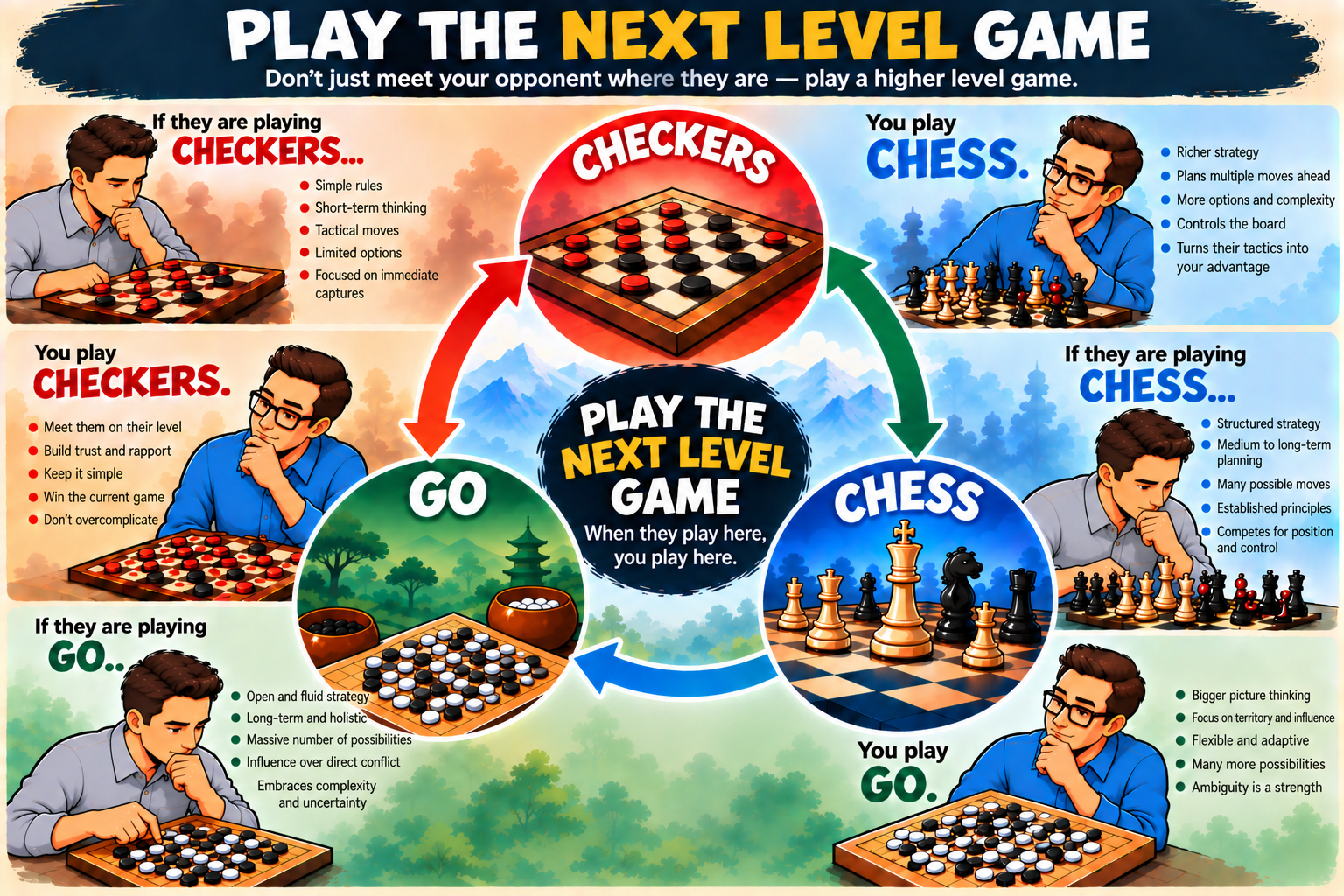
There is a saying I have come to like:
If they are playing checkers, play chess.
If they are playing chess, play Go.
If they are playing Go, play checkers.
At first, it sounds like a lesson in always playing a more complicated game. I don’t think that’s the point.
The point is not to let someone else define the game you are playing.
Every environment has rules—some written, some assumed. Every disagreement, negotiation, project, or organizational challenge develops a pattern of behavior. Once that pattern becomes predictable, we tend to respond within the same framework.
That’s where we get stuck.
Don’t Play Their Game
If someone wants every conversation to become a tactical argument, you can spend all day winning individual arguments and still lose the larger objective.
If someone is thinking three moves ahead, responding with another three-move strategy may simply create a better chess match.
And if everyone is operating at a highly complex, strategic level, sometimes the most powerful move is to simplify the problem.
The objective isn’t to be more complicated. The objective is to change the game.
Moving to the “next level” means changing the rules, timeframe, perspective, or objective that determines how the situation is being played.
Sometimes that means thinking bigger. Sometimes it means thinking longer. And sometimes it means making something dramatically simpler.
Complexity Isn’t Intelligence
We often equate sophistication with complexity. But a complicated solution to a simple problem is still a bad solution.
The real advantage comes from understanding what game is actually being played and recognizing when the existing game is no longer serving the outcome you want.
In business and leadership, this happens constantly. Teams argue about processes, solutions, and positions until everyone becomes better at defending their perspective—but nobody gets closer to the desired outcome.
Changing the game might mean moving the conversation from defending a solution to aligning around the outcome.
Now you’re playing a different game.
The Loop Matters
There is no permanent “highest” game.
Chess isn’t always better than checkers. Go isn’t always better than chess. Sometimes the smartest move is to go backward in complexity.
The real skill is recognizing which game the situation requires.
We can become so attached to being strategic, sophisticated, or complex that we forget the purpose of the game altogether.
Sometimes the person who wins isn’t the person who can see the most moves.
It’s the person who recognizes that the moves don’t matter anymore.
Change the game. Change the frame. Change the objective. Change the rules.
And sometimes, simplify.
Play the next level—not necessarily the harder level.
The next level is simply the level that moves you closer to the outcome you actually want.