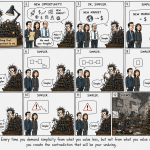
Solution Evolution can make many products Without Solving a single Problem.

Solution evolution can be a good thing. We learn, adapt, and improve. But there is a point where evolution becomes substitution—each new solution simply solves the problems created by the previous one. The pattern becomes: Problem → solution → unintended problem → new solution → new unintended problem → repeat. Each step can look reasonable …

The Rock Game still Doesn’t Work in AI

AI makes iteration incredibly easy. And that’s exactly the problem. If you start building before you understand what you actually need, AI will happily help you refine the wrong thing—faster, cheaper per iteration, and at massive scale. Understand the Problem First Before you ask AI to solve a problem, understand the problem first. What do …

When Your MBR Can Only Report Wins, Goodhart’s Law Goes on Steroids

Imagine a Monthly Business Review of Pearl Harbor. The presenter walks into the room with a confident smile. “Overall, a pretty successful month. Our team showed great resilience.” Ten air-to-air wins. Ten ground-to-air wins. Thousands of servicemen healthy and ready for deployment. A new reef system seeded in the harbor. Green checkmarks everywhere. Sounds pretty …

The Iron Triangle: You Can’t Have It All

Everyone wants the project delivered faster, cheaper, and with more features. The problem? The laws of project gravity still apply. The Iron Triangle—Scope, Time, and Cost—is one of the simplest ways to understand why projects go sideways. Change one side of the triangle and you put pressure on the other two. Want more scope? You …

What happens when you get what you want?

While that vast majority of information technology strategy for internal back office capability’s enablement is taken from a Rolling Stones Song lyric “ you can’t get what you want you get what you need “ (paraphrased for effect) the reality is for technology and business teams alike the real question great architects should always ask …

Possibility of possible

Probability has little to do with possibility and vise versa. If it’s possible what ever “IT” is your time with “IT” is never miss spent or wasted. When you can take the possibility.

What is “OK” mean?

Ok, okay, o-k, um ok, oh ok. All mean radically diffrent things to diffrent people. Yet it imused universally as if all know what is meant with 2-4 letters that are more of a single sound in today conversational English than a verbal vocalizations. So to try and help the in this mass assumption in …