
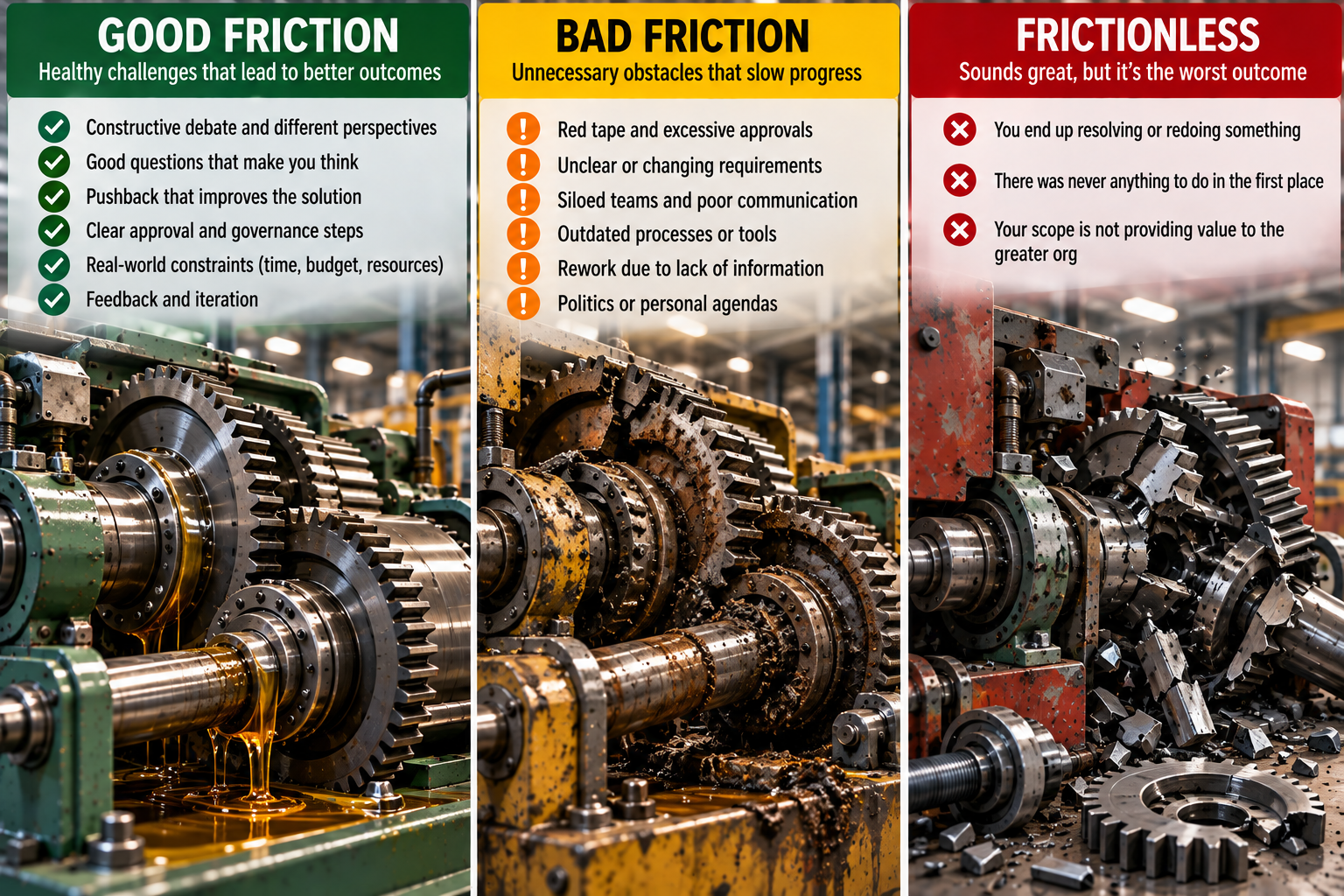
We often talk about friction like it is something to eliminate.
Remove the obstacles.
Streamline the process.
Automate the work.
Make it frictionless.
But I think that misses something important.
Not all friction is bad.
A well-oiled machine still has friction. The parts engage, push against each other, and create the resistance necessary to transfer energy and do useful work.
Organizations are the same.
Good Friction
Good friction makes us stop and think.
It can be a challenging question, a different perspective, constructive pushback, a governance step, or someone asking, “Are we sure this is the right thing to do?”
That friction can make the solution better.
Bad Friction
Bad friction is different.
It is the bureaucracy that adds no value. The unnecessary approval. The silo that prevents information from moving. The outdated process that exists because “that’s how we’ve always done it.”
Bad friction consumes energy without improving the outcome.
It is the machinery that hasn’t been maintained.
But Then There Is Frictionless
This is the one we should be careful about.
If something is completely frictionless, we may assume we’ve achieved perfection.
But what if we simply removed every mechanism that challenged the work?
You end up resolving or redoing something.
There was never anything to do in the first place.
Or your scope isn’t providing value to the greater organization.
A machine with no resistance isn’t necessarily operating perfectly. It may simply not be doing anything useful.
The goal shouldn’t be to eliminate friction.
The goal should be to understand it.
Keep the friction that makes the outcome better.
Remove the friction that only slows you down.
And question whether frictionless actually means valuable.
So, when you look at your team, your processes, or your projects:
Are you dealing with good friction, bad friction, or no friction at all?