
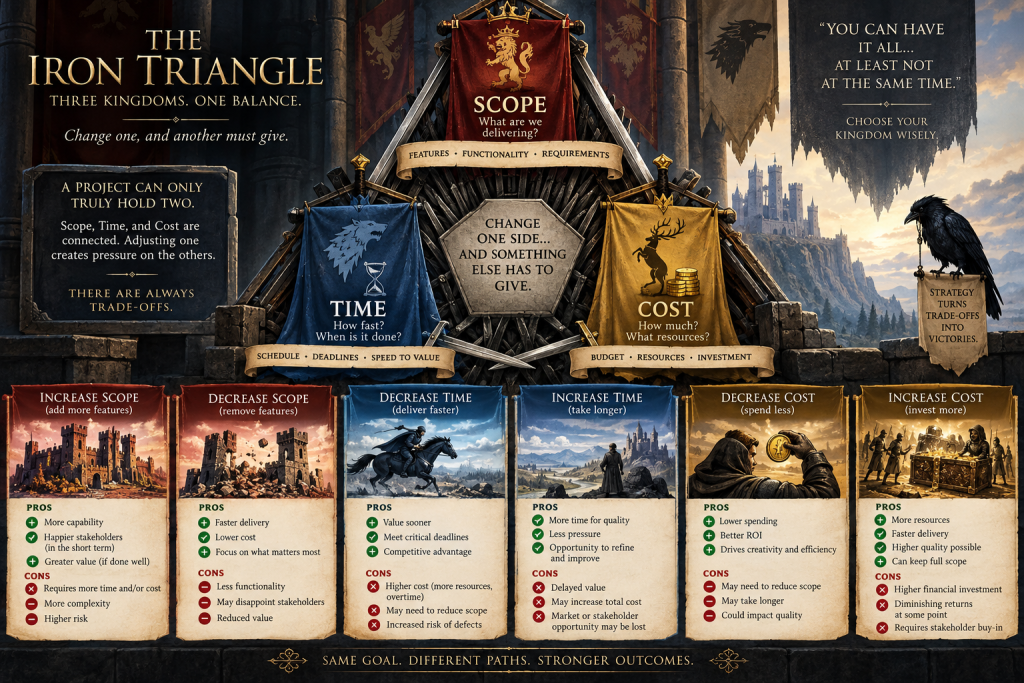
Everyone wants the project delivered faster, cheaper, and with more features. The problem? The laws of project gravity still apply.
The Iron Triangle—Scope, Time, and Cost—is one of the simplest ways to understand why projects go sideways. Change one side of the triangle and you put pressure on the other two. Want more scope? You probably need more time, more money, or both. Need it faster? You may need more resources or you may have to sacrifice scope. Need to cut the budget? Something else has to give. The mistake isn’t changing a constraint—the mistake is pretending there isn’t a consequence.
The interesting part is that there is no universally “right” trade-off. Sometimes spending more money to accelerate delivery is exactly the right decision. Sometimes reducing scope is the smartest move because delivering the most important 60% today is more valuable than delivering 100% six months from now. And sometimes slowing down is the best decision because quality, adoption, or long-term sustainability matter more than hitting an arbitrary deadline. The real leadership decision is determining which trade-off creates the most business value.
This is where the Iron Triangle becomes more than a project-management diagram. It becomes a decision-making tool. Instead of asking, “How do we get everything we want?”, ask, “Which constraint are we willing to move, and what are we getting in return?” That simple shift changes the conversation from arguing about impossible commitments to making explicit choices. The best leaders don’t eliminate trade-offs—they choose where the trade-off goes.
The Bottom Line
Projects don’t fail because someone moved one side of the triangle.
They fail when someone moves one side and pretends the other sides won’t move too.
The next time someone says, “We need it faster, we can’t spend more, and we can’t reduce scope,” don’t argue.