
Education is generally understood as the process of acquiring knowledge, developing intelligence, and preparing individuals to use both in the world. But those are not necessarily the same thing, and the distinction matters.
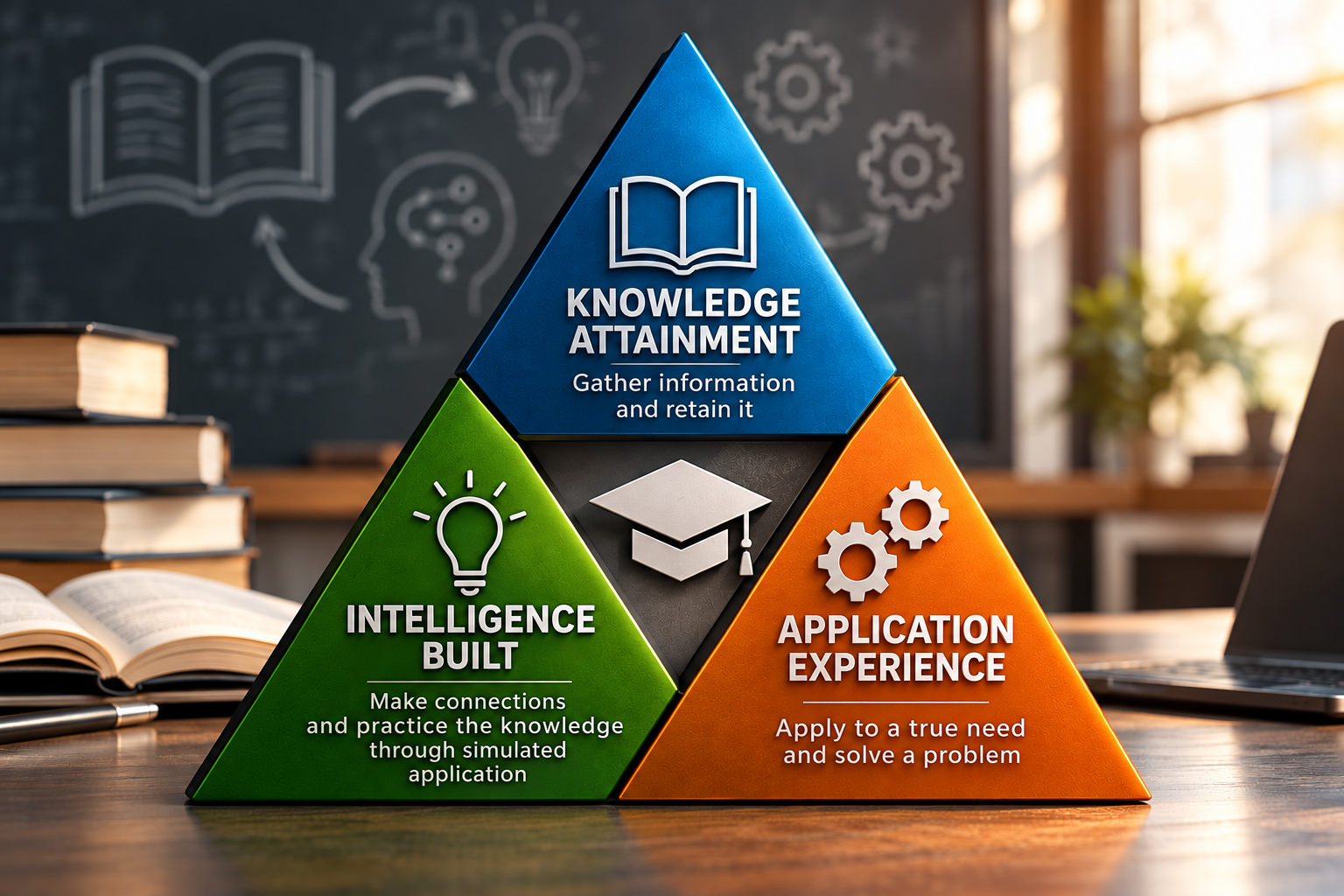
I see education as three connected components: Knowledge Attainment, Intelligence Built, and Application Experience. Each serves a different purpose, and each contributes to an individual’s ability to function beyond the classroom.
The problem is that our traditional educational system places considerable emphasis on the first two while largely leaving the third unaccounted for. The result is a gap between what an individual has learned, what they can demonstrate academically, and what they are actually prepared to do.
1. Knowledge Attainment
Knowledge Attainment is the acquisition and retention of information. It is the process of presenting information through different formats and methods, with the objective of helping an individual understand and retain it.
This includes facts, figures, dates, events, concepts, observations, and other forms of information. Reading, lectures, textbooks, demonstrations, note-taking, and repetition are all methods used to support knowledge attainment.
At this stage, the primary objective is to establish an information base. The individual is being exposed to information and developing a repository of knowledge that can be accessed later.
This is the foundation of education and, arguably, the component that receives the greatest share of attention in traditional educational environments.
2. Intelligence Built
Intelligence Built is the development and demonstration of an individual’s ability to recall, connect, interpret, and build upon acquired knowledge.
This is where testing, classwork, research papers, assignments, and structured academic exercises come into play. These activities require individuals to retrieve information, recognize relationships between concepts, combine information, and demonstrate their understanding in measurable ways.
The distinction between Knowledge Attainment and Intelligence Built is important. Knowing information and being able to work with that information are two different capabilities.
An individual may memorize historical events, scientific principles, or business concepts. Demonstrating intelligence requires more than remembering those things; it requires connecting them, interpreting them, and using them to construct a meaningful response within the context of an exercise.
However, even this has a limitation. The ability to recall, connect, and manipulate information in a structured academic environment does not necessarily demonstrate the ability to apply it when confronted with an actual situation.
3. Application Experience
Application Experience is the use of acquired knowledge and developed intelligence in response to real-world circumstances, needs, problems, or opportunities.
Unlike structured academic exercises, real-world situations do not necessarily come with a clearly defined problem, a predetermined set of information, or an established path to an answer. Circumstances can be incomplete, conflicting, ambiguous, or simply accepted as normal despite presenting an opportunity for improvement.
Application requires an individual to take what they know and what they have learned to do with that knowledge and put it to use in circumstances that exist beyond the classroom.
This can mean diagnosing an issue when the symptoms do not point to an obvious answer, recognizing an inefficiency that others have accepted, or responding to a need that emerges from changing circumstances.
The important distinction is that application is not simply completing an exercise designed to demonstrate knowledge. It is putting knowledge and intelligence to work in the context of something that actually needs to be addressed.
4. Where the Traditional Educational System Falls Short
This is where I believe the disconnect exists in the US educational system.
The system has established methods for delivering knowledge and measuring how well individuals retain, recall, connect, and build upon that knowledge. It has textbooks, curricula, examinations, grades, academic standards, and credentials. These are all mechanisms for managing and evaluating the first two components.
Application Experience is different. The system can create assignments, tests, simulations, and academic challenges, but it cannot necessarily manufacture a genuine need for an individual to apply what they know.
An academic requirement is still an imposed objective. A student may need to pass an examination, complete a project, or earn a degree. Those objectives may be challenging, and some students may find genuine meaning in them, but satisfying an academic requirement is not automatically the same as applying knowledge and intelligence to a real-world need.
Consequently, application is largely left outside the system’s established educational process. The expectation is that individuals will eventually take what they have learned and demonstrate its value when they enter the world beyond academia.
But the professional world makes this gap visible.
Consider the MBA graduate. They may be among the most academically accomplished individuals an educational institution can produce. They have acquired extensive knowledge of business, demonstrated their ability to analyze complex subjects, and earned an advanced credential. Yet that credential does not necessarily prepare them to step directly into an executive or leadership position. Organizations often require them to start in lower-level or developmental roles, where they can gain experience applying what they have learned in the context of actual responsibility.
Contrast that with a US Marine Corps Officer Candidate School graduate. Upon commissioning, that individual is placed into a leadership role. Their preparation is not limited to acquiring knowledge and demonstrating academic understanding. It includes practical leadership experiences and the expectation that they will apply their training while carrying real responsibility.
These are different educational models, with different expectations around application.
The point isn’t that an MBA graduate lacks intelligence or that a military officer necessarily has more knowledge. The point is that academic achievement and demonstrated application are not interchangeable.
And this is the gap: we have built an educational system that can measure what people know and how well they can work with that knowledge, but those measurements do not establish whether they can apply it.