
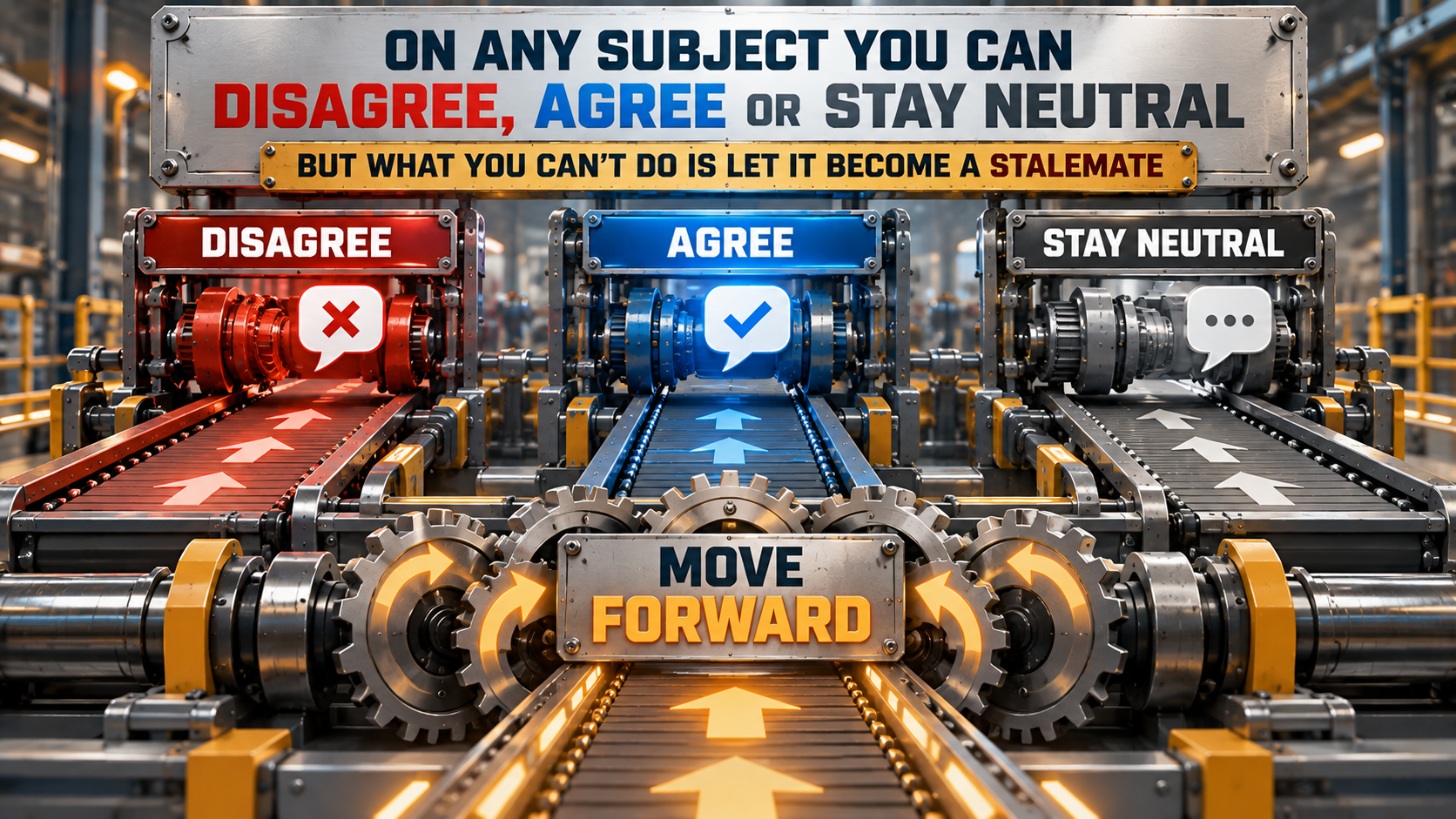
On any subject, you can disagree, agree, or stay neutral. But what you can’t do is let it become a stalemate.
Healthy organizations don’t require everyone to think the same. They require people to challenge ideas, understand different perspectives, make decisions, and then move forward.
You don’t have to agree.
You do have to play your part.
| 🔴 DISAGREE | 🔵 AGREE | ⚪ STAY NEUTRAL |
|---|---|---|
| DO YOUR PREP WORK | DO YOUR PREP WORK | DO YOUR PREP WORK |
| • Fact-based opinion, not preference• History can help, but don’t fall for it• Make sure your position is defensible• Know your red lines and accept their consequences | • Know your facts and figures• Look for the angles• Make sure your position is defensible• Have a rip cord• Know your red lines and accept their consequences | • Understand the issue• Understand both sides• Don’t flip-flop• Neutrality is a position |
| VOICE YOUR CONCERN | LET CONCERNS BE VOICED | DON’T BECOME THE REFEREE |
| • Voice your concern with an audience• Make your point, don’t labor it• Once you’ve made the point, don’t make it again• “I told you so” never looks good | • Give concerns room to surface• Don’t deny or discredit decent concerns• Welcome those who disagree to voice it upward• Encourage the conversation before the decision | • You don’t have to solve every stalemate• You are not automatically the devil’s advocate• Don’t spectate while others fight• Call the deadlock when you see it |
| KNOW YOUR RED LINES | KNOW YOUR RED LINES | REPRESENT BOTH SIDES FAIRLY |
| • If you reach one, make everyone aware• Raising the issue is M.A.D.—be ready• Accept the consequences | • Give warning when you’re at the tipping point• Know what you will and won’t support• Accept the consequences | • If you go upward, give both sides• Don’t advocate for one side while claiming neutrality• Make sure the decision-makers understand the full picture |
| THEN MOVE FORWARD | THEN MOVE FORWARD | THEN MOVE FORWARD |
| • Once the decision is made, let it go• Don’t undermine the decision• Support the direction and execute | • Once you move forward, let it lie• Support the direction• Focus on execution | • Your role may be to help the organization see the issue clearly• Don’t allow neutrality to become paralysis• Support the process and move forward |
THE COMMON REQUIREMENT
The three positions are different, but they all have the same responsibility:
MOVE FORWARD.
You can disagree with the decision.
You can agree with the decision.
You can remain neutral.
But you cannot allow the disagreement to become a stalemate.
A healthy organization doesn’t need everyone to leave the room thinking the same thing.
It needs everyone to leave the room knowing:
What was decided.
Why it was decided.
What their role is.
And what happens next.
Sometimes the most mature outcome is:
“We still disagree, but we’ve made a decision—and we’re moving forward.”
That’s not failure.
That’s organizational maturity.
THE RULE
Disagree respectfully.
Agree thoughtfully.
Stay neutral when appropriate.
But whatever position you take—don’t let it become a stalemate.