
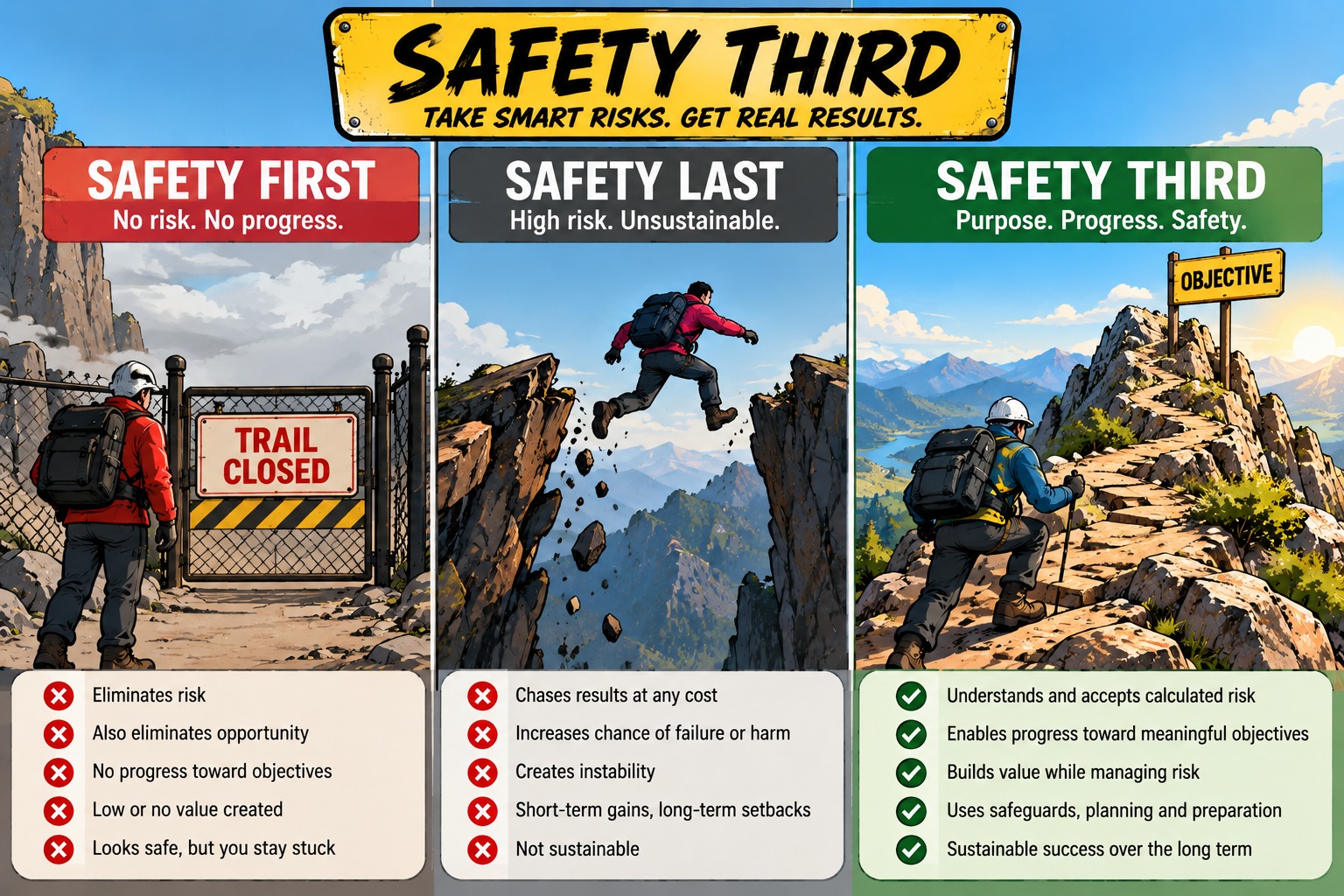
We’ve been taught that safety comes first.
It sounds right. It sounds responsible. But there’s a problem with it:
If safety is truly first, you can eliminate risk by eliminating action.
No risk means no movement.
No movement means no progress.
And without progress, there is no new value or meaningful outcome.
That doesn’t mean safety doesn’t matter.
It means safety shouldn’t be the objective.
Safety Third
Think of it this way:
1. Purpose — What are we trying to accomplish?
2. Progress — What are we willing to do to move toward it?
3. Safety — How do we take that risk responsibly?
This changes the conversation.
Instead of asking:
“How do we eliminate the risk?”
We ask:
“How do we take the risk safely enough to pursue the objective?”
That might mean testing before launching, creating a backup plan, putting controls in place, or taking a smaller step before taking a bigger one.
The risk doesn’t disappear.
We manage it.
Safety First Can Become a Trap
When safety becomes the first and most important consideration, the easiest answer is often don’t do it.
Don’t change the process.
Don’t try the new technology.
Don’t enter the market.
Don’t make the investment.
Don’t take the chance.
Eventually, you’ve created something very safe.
And completely stagnant.
Safety Third Isn’t Safety Last
There is an important distinction.
Safety Last:
Take the risk. We’ll figure it out later.
Safety Third:
Understand the objective. Understand the risk. Build the safeguards. Then take the risk.
That’s the difference between recklessness and calculated risk.
The goal isn’t to create a world without risk.
The goal is to create enough safety that we can responsibly take the risks required to create something better.
Safety isn’t the destination.
It’s what allows us to make the journey.