
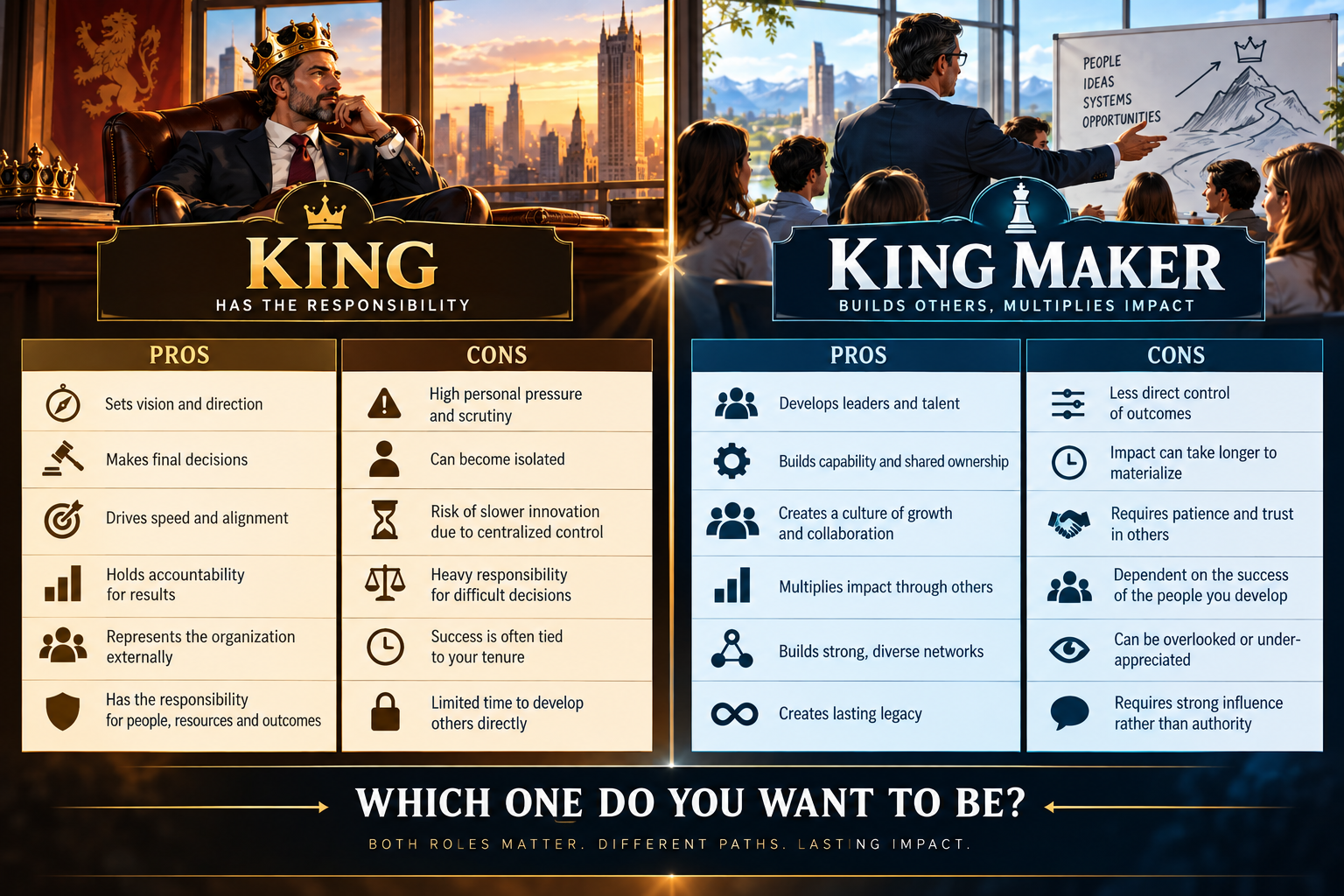
In business, we often celebrate the person at the top.
The person making the decisions. Setting the direction. Taking responsibility when things go wrong. Carrying the weight of the organization on their shoulders.
That is the King.
But there is another role that can be just as powerful: the King Maker.
The King Maker isn’t necessarily the person with the title, the authority, or the final vote. Their influence comes from developing people, creating opportunities, building capability, and helping others become successful.
Neither role is inherently better.
The King
Being the King means accepting responsibility.
You set the vision. You make the difficult decisions. You create alignment when there isn’t agreement. When the organization succeeds, you are accountable for the outcome. When it fails, the responsibility ultimately comes back to you.
But that position comes with a cost.
The pressure is higher. Decisions can become centralized. Your own capacity can become the organization’s limiting factor. And the more responsibility you carry, the harder it can be to step away.
The King Maker
The King Maker plays a different game.
Instead of asking, “How do I make this successful?”, they may ask, “How do I make the people around me more capable of making this successful?”
They build leaders. They create networks. They transfer knowledge. They give others opportunities to make decisions and succeed.
The tradeoff is that influence without authority requires patience and trust. Results may take longer. You don’t control every decision. And sometimes the people you develop will eventually move beyond you.
But that may be the point.
Your impact doesn’t have to end where your authority ends.
So which one should you be?
The answer may depend on the situation.
Organizations need people willing to sit in the chair and accept responsibility.
They also need people willing to build the people who will eventually sit in that chair.
The interesting question isn’t whether one is better.
It’s which role do you want to play—and when?
Because leadership may not be about choosing between being the King or the King Maker.
It may be about knowing when to wear the crown and when to help someone else earn it.
Which one do you want to be?